
Cracking Enterprise DAM Systems: Autonomous Ingestion Across Scene7, Bynder & Media Hubs
How I built an autonomous asset harvesting machine that reverse-engineers parameterized image servers, bypasses manual export dead-ends, resolves thousands of multi-angle product galleries, and introduces vector visual search to identify colors and metals directly from raw images.
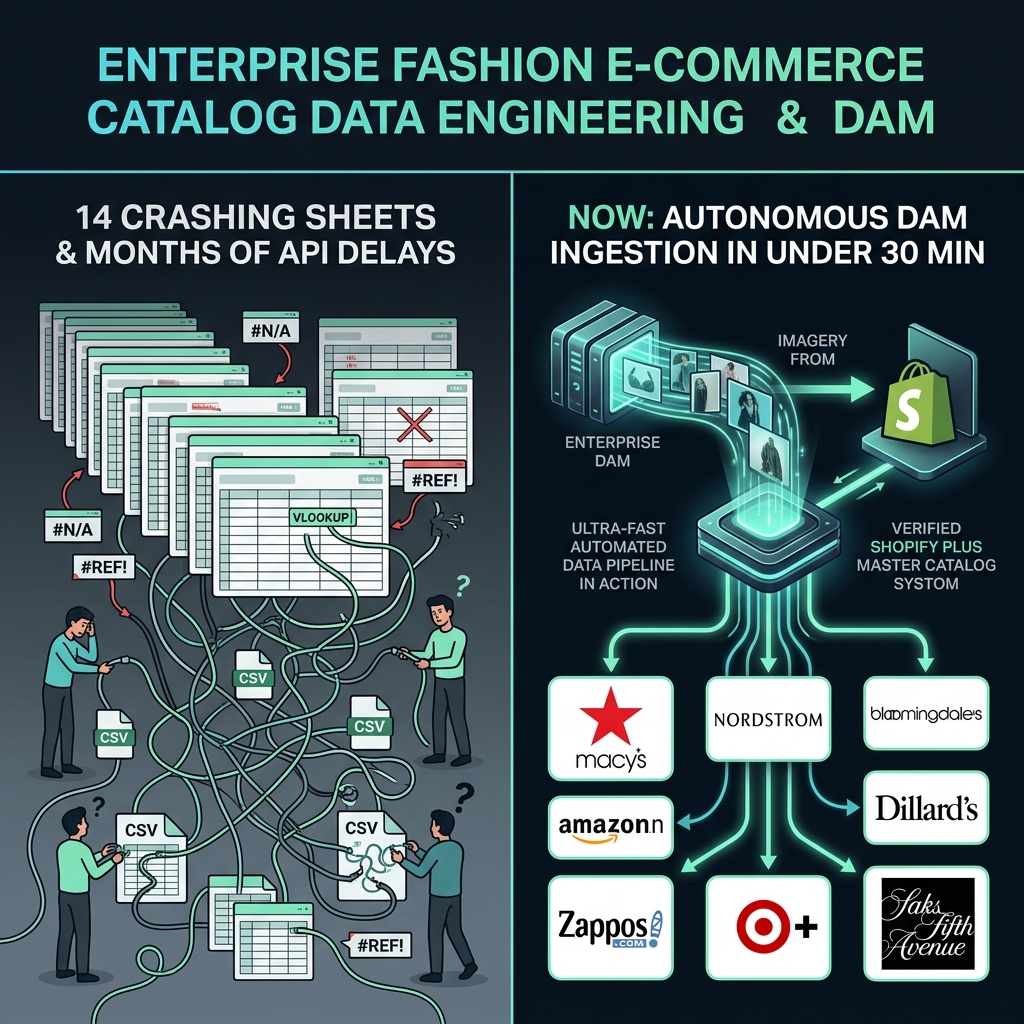
1. The Core Engineering Challenge: Media Trapped in Enterprise Silos
When enterprise fashion, sportswear, and footwear brands migrate or syndicate catalogs to Shopify or custom headless storefronts, product data is only half the battle. The far more difficult bottleneck is product imagery.
Suppliers and global brands rarely hand you a clean folder of high-resolution JPEGs. Instead, assets are locked inside closed Digital Asset Management (DAM) environments. Each server architecture uses proprietary coordinate systems, parameterized transforms, and non-standard angle naming conventions. Manual downloading at catalog scale (tens of thousands of items) requires weeks of human labor, inevitably leading to mismatched colorways, missing sole/profile views, and broken variant links.
Adobe Dynamic Media / Scene7 (e.g. Under Armour Engine)
The Architecture: Adobe Scene7 does not serve static files; it serves dynamic image processing instructions via the /is/image/ protocol. Angles and high-res variants are synthesized on the fly based on query strings.
The Solution: I built an automated probe engine that decomposes the SKU matrix into predictable dynamic endpoints, probing for all canonical angle modifiers (DEFAULT, PAIR, TOE, SOLE, A, B), while parameterizing resolution and sharpness for clean export:
Bynder Enterprise DAM (e.g. Reebok Asset Library)
The Architecture: Over 18,283 master assets across 3,626 footwear and apparel articles were locked behind Bynder's media hub without bulk export tooling. Assets were indexed by internal GUIDs rather than direct public SKUs.
The Solution: Engineered a batch metadata scraper that traversed Bynder's collection endpoints, correlated internal article UUIDs with global ERP product codes, deduplicated identical hero images using 64-bit perceptual hashing (pHash), and organized full 7-angle galleries per colorway.
Enterprise Content Hub & Edge CDN (e.g. Saucony / Wolverine Pipeline)
The Architecture: Akamai and Cloudflare multi-tier edge distributions hosting separate desktop, mobile, and lifestyle asset trees across 108,999 SKUs.
The Solution: Deployed a high-concurrency headless extraction crawler that mapped primary colorway swatches to full zoom-tier packages, validated response byte sizes, and uploaded them directly to Shopify CDN with atomic variant associations.
2. Advanced Capability: Vector Visual Search & Material Recognition (Beta)
Computer Vision · Deep EmbeddingsExtracting images is only step one. How do you guarantee that an extracted image actually matches the supplier's colorway name? What happens when a feed says "Midnight Mist" but the image shows bright silver?
Automated Color & Metal Classification
To eliminate human QA on 100,000+ images, I introduced a lightweight vision model that generates vector embeddings for each cropped product image:
- Colorway Cluster Verification: Embeds the dominant color palette into LAB / vector space, catching mismatches (e.g. green variant mapped to a red shoe) before push to production.
- Metal & Alloy Classification: Specifically engineered for jewelry, luxury goods, and hardware: differentiates yellow gold, rose gold, stainless steel, platinum, and matte titanium directly from specular highlight profiles.
- Zero-Shot Spec Enrichment: Generates structured filter attributes (e.g.
material: stainless_steel,finish: brushed) automatically without manual data entry.
3. Real Production Impact
Reduced asset harvesting and gallery preparation time from 3.5 weeks of manual work down to 22 minutes of fully automated pipeline execution.
100% gallery completion rate: Every single active SKU received its primary hero, lateral, medial, sole, and angle detail views with zero broken links.
Independent of vendor API limits: Direct CDN probing and stream downloading bypasses restrictive rate limits without hitting throttling ceilings.
Have media locked in enterprise DAMs or complex catalogs?
Let's discuss how an autonomous pipeline can ingest, structure, and verify your assets.